


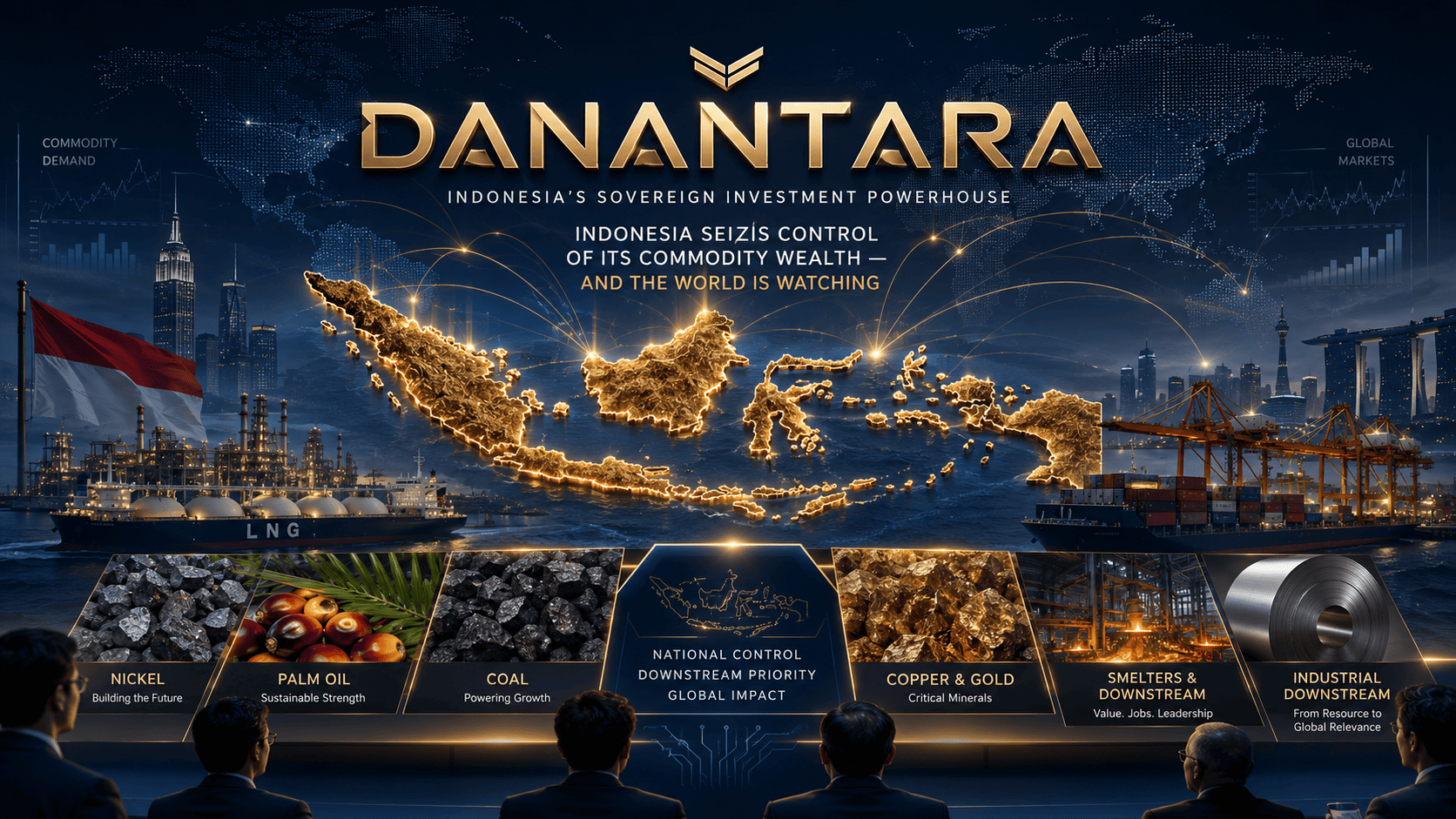
JAKARTA - Indonesia is sitting on some of the world's most valuable natural resources and it's done letting others profit from them on their terms. In a sweeping policy shift that could reshape global supply chains for palm oil, coal, and nickel, President Prabowo Subianto has handed the state control over Indonesia's most lucrative exports. For traders, manufacturers, and investors from Rotterdam to Seoul, the question is no longer if this changes things it's how much.
Signed on May 20, 2026 and officially enacted on June 5, the Government Regulation on Natural Resource Commodity Export Governance is the most assertive move Jakarta has made in decades to reclaim economic sovereignty over its resource sector. It is also, by any measure, a direct challenge to the way global commodity trade has operated in Southeast Asia's largest economy.
The regulation's core mechanism is straightforward and deliberately disruptive to the status quo.
Private companies can no longer export designated strategic commodities freely. All such transactions must now flow through or be mediated by PT Danantara Sumber Daya Indonesia (DSI), a state entity linked to Indonesia's sovereign wealth fund, Danantara. In effect, DSI becomes the gatekeeper of Indonesia's most critical export pipeline.
The initial list of controlled commodities reads like a who's who of global resource markets:
- Palm oil Indonesia supplies nearly 60% of the world's output
- Coal a cornerstone of Asian energy markets and a key source of Indonesian foreign exchange
- Ferroalloys and nickel products materials that are rapidly becoming the lifeblood of the global electric vehicle industry
These are not peripheral goods. They are commodities that move markets, power factories, and underpin entire industrial supply chains across Asia, Europe, and beyond.
Jakarta is not moving carelessly. The rollout follows a deliberate, phased structure designed to minimize disruption at least in theory.
From June through August 2026, a formal transition period is underway. Existing export contracts are being reviewed and gradually migrated into the new framework. Businesses with active deals have been given breathing room but the clock is ticking.
From September 2026, full enforcement begins. By year's end, every export of a designated strategic commodity must comply with the regulation. There are no announced exceptions.
For multinational buyers and trading houses that have built long-term procurement relationships with Indonesian suppliers, the next several months will be critical. How smoothly DSI absorbs that volume and how transparent its processes prove to be will shape the early verdict on this policy.
Beyond controlling the export channel, the regulation targets something equally significant: where the money ends up.
Under the new rules, foreign exchange earnings from strategic commodity exports must be routed through state owned banks, in accordance with Bank Indonesia Regulation No. 5 of 2026. Additional provisions limit immediate rupiah conversion and require exporters to retain a portion of proceeds onshore.
The intent is twofold: strengthen Indonesia's foreign exchange reserves and close the door on capital flight the quiet hemorrhage of export earnings that has, according to the government, cost the country dearly for generations.
Whether these capital retention measures prove effective or simply push transactions toward workarounds will be one of the most closely watched dynamics of the regulation's early months.
To understand why this regulation exists, it helps to understand the frustration driving it.
President Prabowo has spoken with unusual bluntness about what he sees as decades of institutional failure. His government's position: Indonesia has been systematically undervalued in global commodity trade its resources sold cheap, its export revenues manipulated through transfer pricing, under invoicing, and other mechanisms that enriched intermediaries while depleting the national treasury.
"We don't want low revenue only because we have no courage to manage our own resources." President Prabowo Subianto, May 2026
In remarks that were equal parts policy rationale and political declaration, Prabowo's words signal a government prepared to absorb short-term friction in pursuit of long-term economic control.
The government claims that these practices have cost Indonesia hundreds of billions of dollars over time a figure that, if accurate, would represent one of the largest sustained resource revenue losses of any major commodity-exporting nation. Independent verification of that estimate remains limited, but the underlying problem commodity trade opacity is well-documented across the sector globally.
The initial market response was measured concern rather than panic.
Shares in Indonesian mining and commodity-linked companies eased following the announcement, reflecting uncertainty about implementation rather than outright rejection of the policy. Foreign investors expressed the predictable set of concerns: potential disruption during transition, new compliance costs, the risk of slower deal timelines, and questions about how DSI will price its intermediary role.
These concerns are legitimate. The introduction of a mandatory state intermediary into a previously market-driven export system carries genuine operational risks particularly during a transition period when rules are still being clarified.
The government's response has been to emphasize continuity: existing contracts will be honored, enforcement will be phased, and the long-term goal is a more transparent and equitable trade environment that ultimately benefits responsible actors in the sector.
Whether that reassurance proves sufficient will depend heavily on how implementing guidelines expected from the Ministry of Trade are drafted and enforced.
For international observers, the significance of this regulation extends well beyond Indonesia's borders.
Indonesia is not a minor supplier in any of the three commodity categories targeted. It is the world's dominant palm oil producer, a top five thermal coal exporter, and holds the largest proven nickel reserves on earth a resource that has become central to the global transition to electric vehicles.
Supply chain planners in European manufacturing hubs, battery procurement teams in South Korea and Japan, and commodity desks in Singapore and London are all paying close attention. A shift in how Indonesia manages these exports even a temporary one driven by transition friction has the potential to move prices and complicate procurement timelines across multiple industries simultaneously.
The broader question is whether this model, if it works, inspires similar moves from other resource rich developing nations that have long felt their commodities were undervalued by global markets. Indonesia may be writing a playbook that others will study closely.
"If Indonesia succeeds in capturing more value from its commodity exports through state intermediation, expect other major producers from West Africa to Southeast Asia to take note." Trade policy analysts, widely cited in regional business press
The regulation's success or failure will become apparent through several measurable indicators in the months ahead:
Trade balance trajectory Does Indonesia capture meaningfully more value per unit exported, or do friction costs and buyer resistance offset the gains?
DSI's operational capacity Can a newly empowered state entity absorb the complexity of managing Indonesia's strategic commodity export flows without creating bottlenecks?
Foreign investment signals Do the major commodity producers operating in Indonesia many of them multinational firms adjust, retrench, or hold the line as the rules become clearer?
Implementing guidelines The Ministry of Trade's forthcoming technical regulations will be the real test. The policy's ambition is clear; its execution remains the open question.